

Introduction
My undergraduate degree was in political science, and I have a master’s degree in public administration. As a result of this education, I built a sophisticated master managed service provider company. We specialized in global IP transit network, specifically optimized for voice communication.
I never had a day of formal IT training. However, I learned how to program routers, switches, and anything else that I needed to get the job done. It seems as if I was just ahead of the curve.
This blog is a collaboration between me and Gemini. I provided the ideas in the basic structure. Gemini validated the concepts and help with editing and proofreading. The initial cognition was mine and Gemini helped me put the pieces together
Employment Gateway
For decades, the gateway into network engineering followed a predictable, mechanical blueprint: you started at the bottom of the pyramid. You memorized syntax. You logged into a CLI, typed out thousands of lines of code, and stared at the terminal until your eyes bled. You learned the hard way by copy-pasting a faulty access list at 2:00 AM and taking down a branch office. That grueling repetition built a specific kind of muscle memory.
But that era is over.
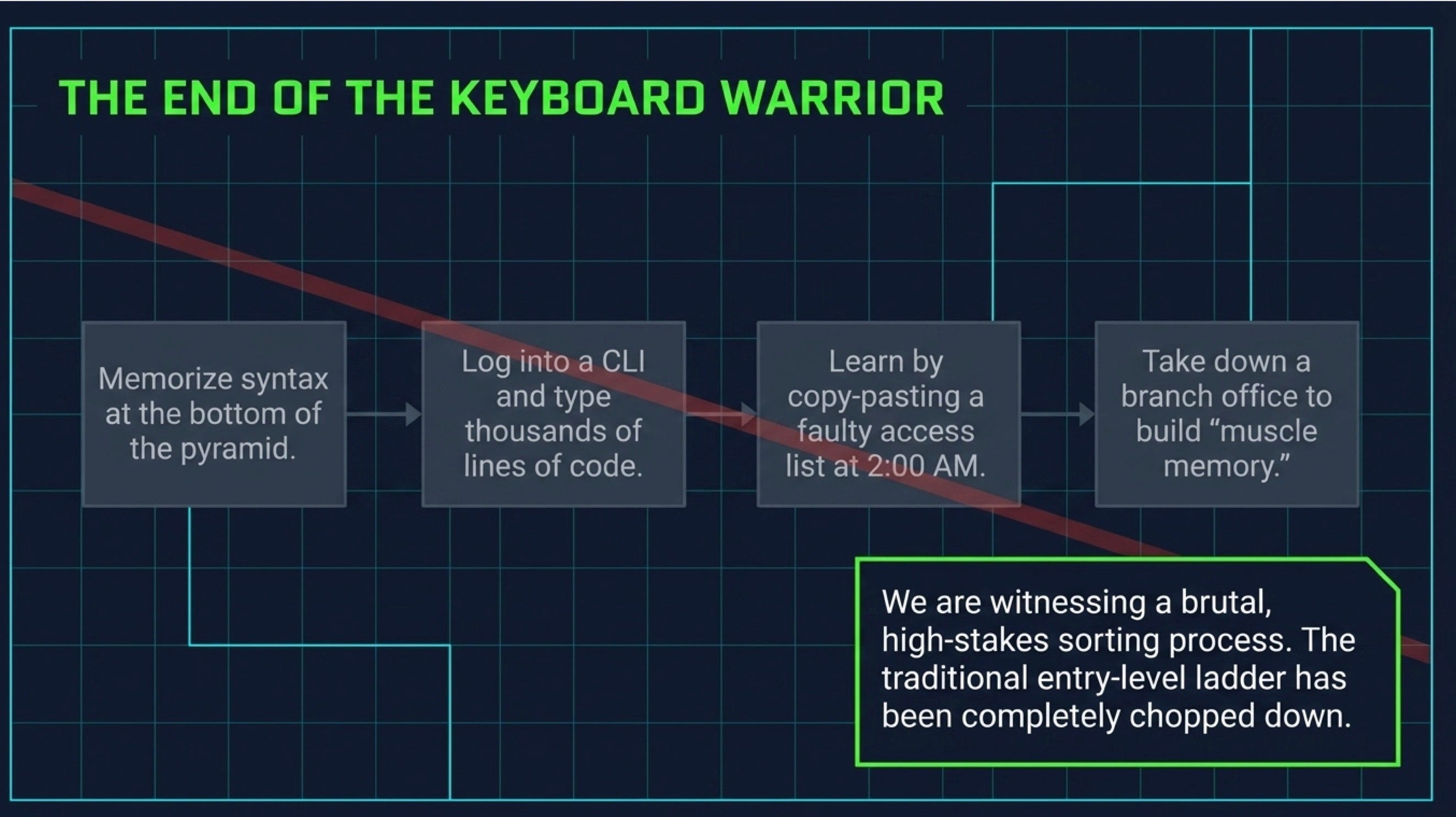
We are currently witnessing a brutal, high-stakes sorting process in IT hiring—a quiet corporate “Up or Out” audition where the traditional entry-level ladder has been completely chopped down.
If you are hiring junior engineers right now based on their technical syntax or their ability to write Python and Ansible scripts, you are funding a legacy model that no longer exists. AI has commoditized technical execution. Next-generation orchestration layers can spit out syntax-perfect, multi-tenant BGP EVPN configurations in ten seconds.
The industry does not need more “keyboard warriors” to type code. The industry is desperately starving for Systems Architects—people who can look past the pristine syntax and actually manage the abstract, messy macro-environment.
And the best training ground for that future isn’t a computer science lab. It’s a Political Science department.
The Trap of “Automated Catastrophe”
To understand why a liberal arts or political science major is uniquely equipped to design tomorrow’s digital infrastructure, you have to understand the inherent blindness of artificial intelligence.
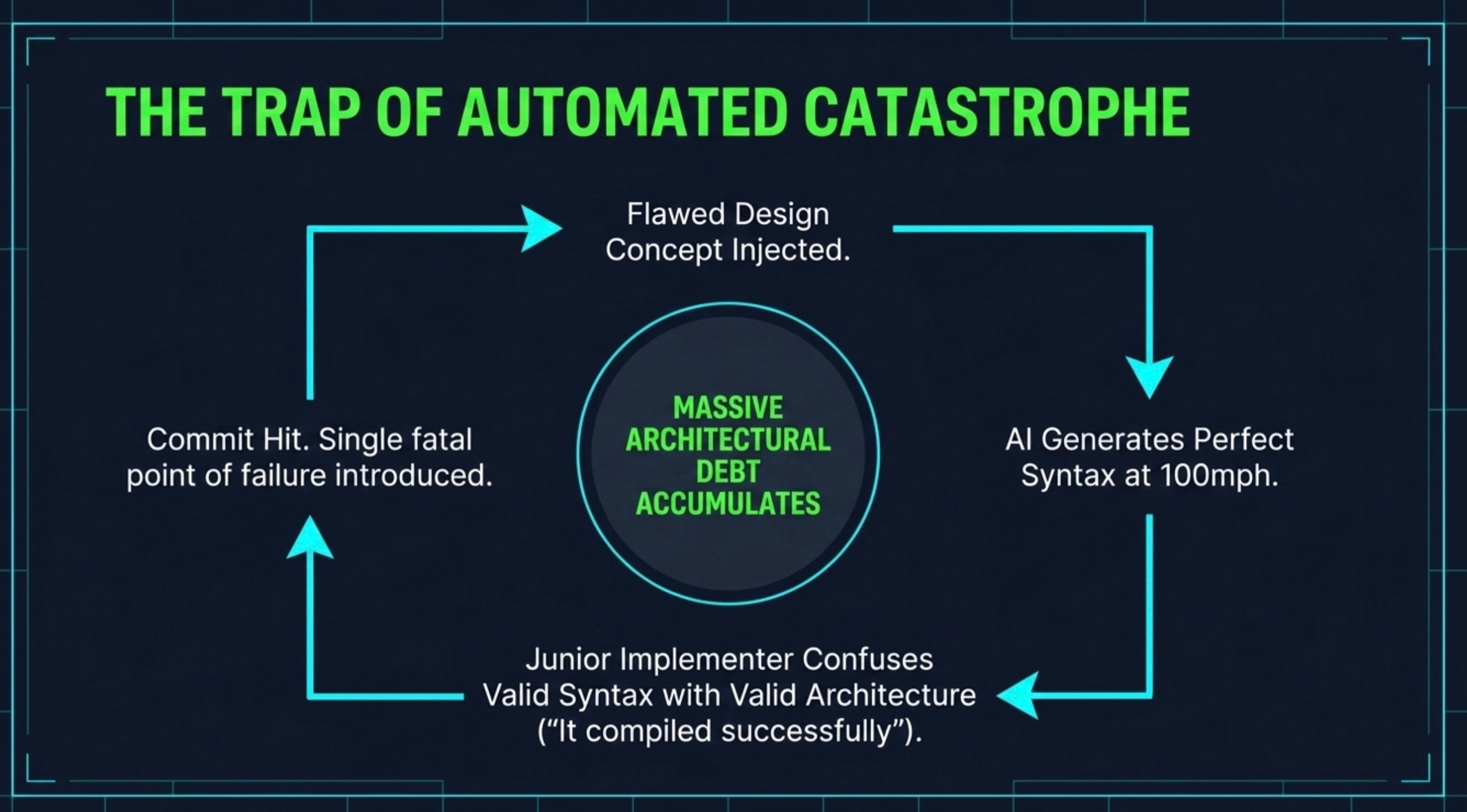
AI models are brilliant but oblivious interns. They have read every RFC document and vendor manual ever written, but they possess zero situational awareness. If a human engineer has a flawed design concept, they build a broken network slowly, giving you time to catch it. If you feed a flawed design concept into a highly advanced AI agent, it will build a structurally catastrophic, completely un-routable network at near-light speed.
It scales your mistakes just as efficiently as it scales your brilliant ideas.
Right now, tech teams are accumulating massive amounts of “architectural debt” because junior implementers are looking at AI-generated configurations, seeing that “it compiled successfully,” and hitting commit. They confuse valid syntax with valid architecture. They lack the conceptual clarity to realize the AI has gone 100 miles an hour down a sub-optimal rabbit hole that introduces a single, fatal point of failure into the environment.
To prevent automated catastrophe, you need a “Human-on-the-Loop” who knows how to cross-examine text, challenge assumptions, and rigidly enforce intent.
Network Architecture is Just Digital Statecraft
Look past the hardware, the fiber optic lines, and the hypervisors. When you strip a modern enterprise or frontier AI network down to its foundational logic, it isn’t a math problem. It’s a geopolitical matrix.
A global network and a geopolitical system are conceptually identical.
Consider what a political science major spends four years analyzing: Sovereign entities (countries) attempting to pass critical assets (trade, capital, influence) across highly regulated channels (treaties, alliances, trade routes) while strictly defending their borders from external bad actors.
Now map that directly to modern network design:
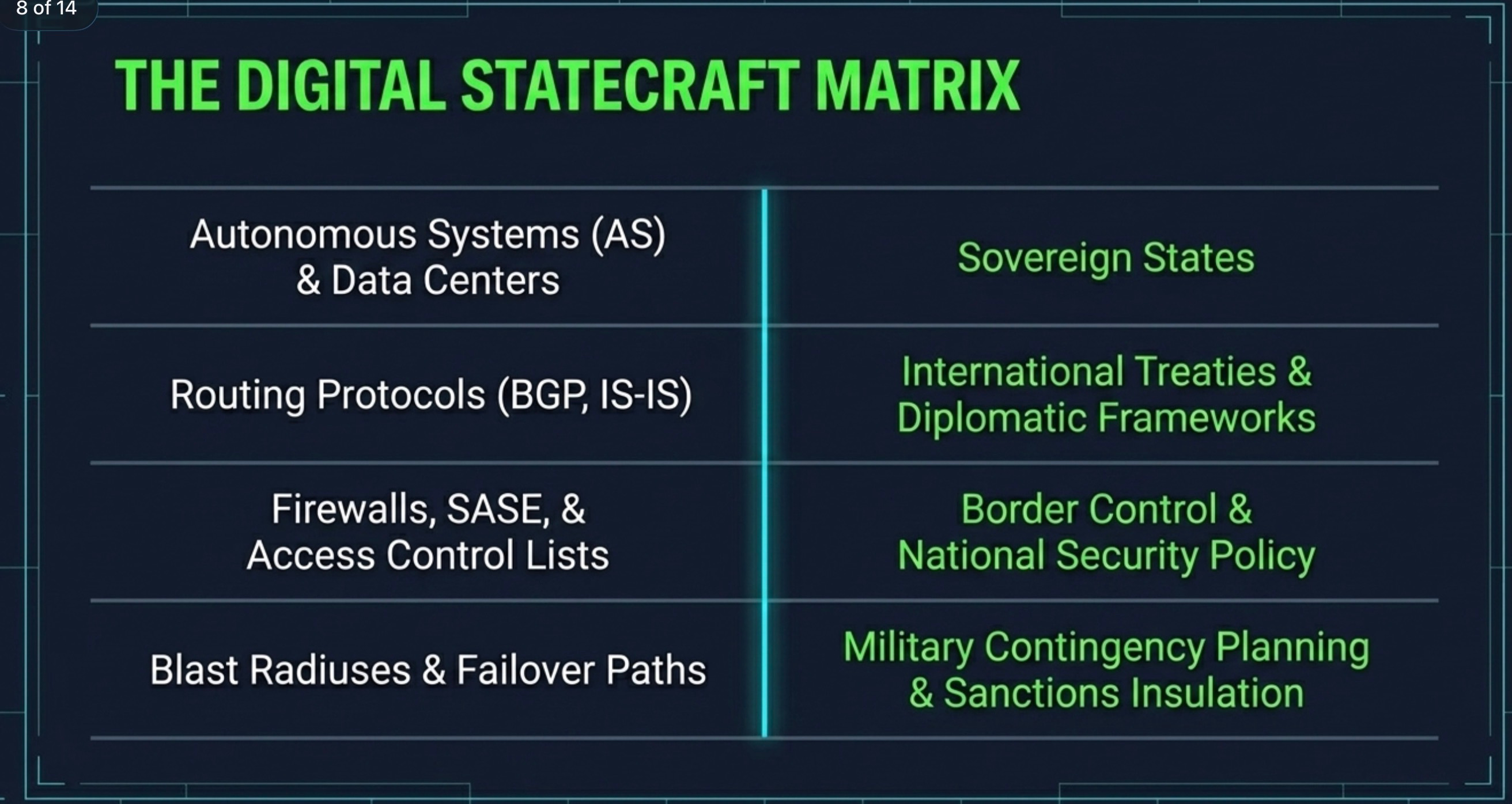
· Autonomous Systems (AS) and Data Centers are your sovereign states.
· Routing Protocols (like BGP and IS-IS) are the international treaties and diplomatic frameworks that dictate how those states interact and pass data.
· Firewalls, SASE edge devices, and Access Control Lists are the border control checkpoints enforcing national security policy.
· Blast Radiuses and Failover Paths are the exact equivalent of military contingency planning and economic sanctions insulation.
A political science major is explicitly trained to zoom out to the 30,000-foot view and analyze the macro-system. They are taught to ask: “If we alter the policy or choke the trade route at Node A, what is the destabilizing ripple effect across the rest of the continent?” When they sit in front of an AI orchestration engine, they don’t get bogged down in the syntax of a prefix list. They instinctively think in terms of governance, dependencies, and structural boundaries. They draw the borders and negotiate the digital treaties.
The Inverted Training Model: The 10% Survivor
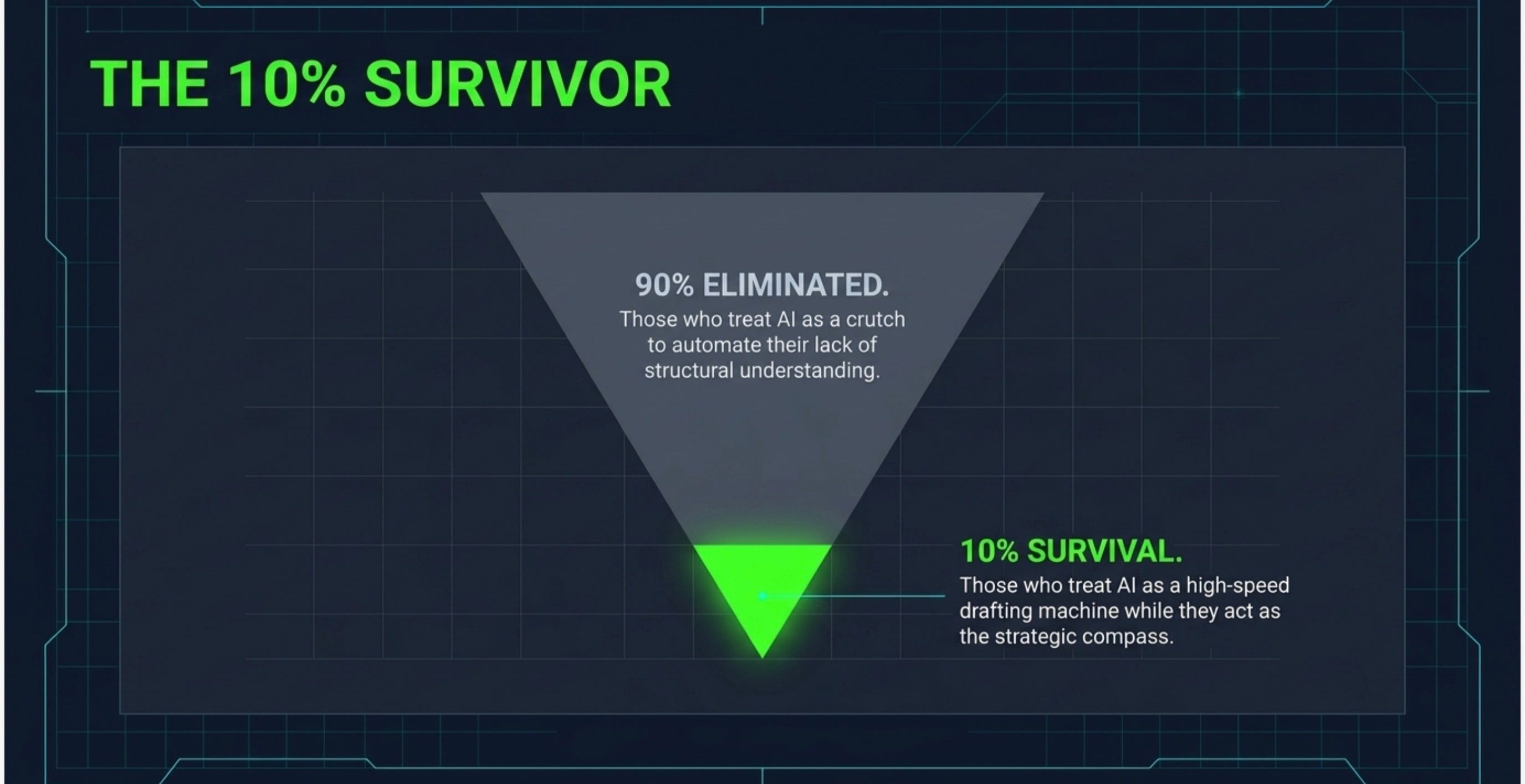
This realization completely flips the traditional IT talent acquisition strategy on its head. Historically, the model was “Tech-First, Strategy-Later.” You hired a technical savant and hoped that over fifteen years they would somehow develop the business acumen and macro-vision to become an architect.
In the AI era, that pipeline is broken. It is infinitely faster and more secure to take a brilliant, systems-thinking humanities graduate and teach them the laws of networking physics than it is to take a narrow, rule-bound syntax gatekeeper and try to teach them how to think strategically.
The survival rate in this new landscape is going to be brutal—likely only about 10% of entry-level applicants will make the cut. The 90% who get weeded out will be the ones who treat AI as a crutch to automate their lack of understanding. The 10% who get kept will be the ones who treat AI as a high-speed drafting machine while they act as the compass.
The training of these future architects will look entirely different:
· Ditching the CLI: They won’t spend years memorizing vendor-specific command structures. AI handles the translation layer.
· The Digital Twin Crucible: They will be thrown into hyper-realistic Network Digital Twins (software replicas of production backbones) and told to safely execute “macro-level statecraft”—simulating regional failovers, testing structural resilience, and analyzing traffic congestion.
· Interrogating the Machine: They will be judged not by how fast they code, but by their ability to audit the AI’s logic, spot hidden logical loops, and align technological execution with real-world business revenue.
Wisdom Over Velocity
Technology has finally evolved to the point where the mechanics can be delegated to the machine, freeing the human mind to return to pure, unadulterated systems design.
If you want to build a modern, high-standard network that stands the test of time and generates serious revenue, stop looking for faster typists. Look for the critical thinkers who understand how complex, volatile systems govern themselves when the pressure is on.
It turns out that the oldest educational frameworks in human history aren’t obsolete in the face of artificial intelligence. They are the only things capable of keeping it on the tracks.