

The Real AI Danger Is Not the One You’re Worried About
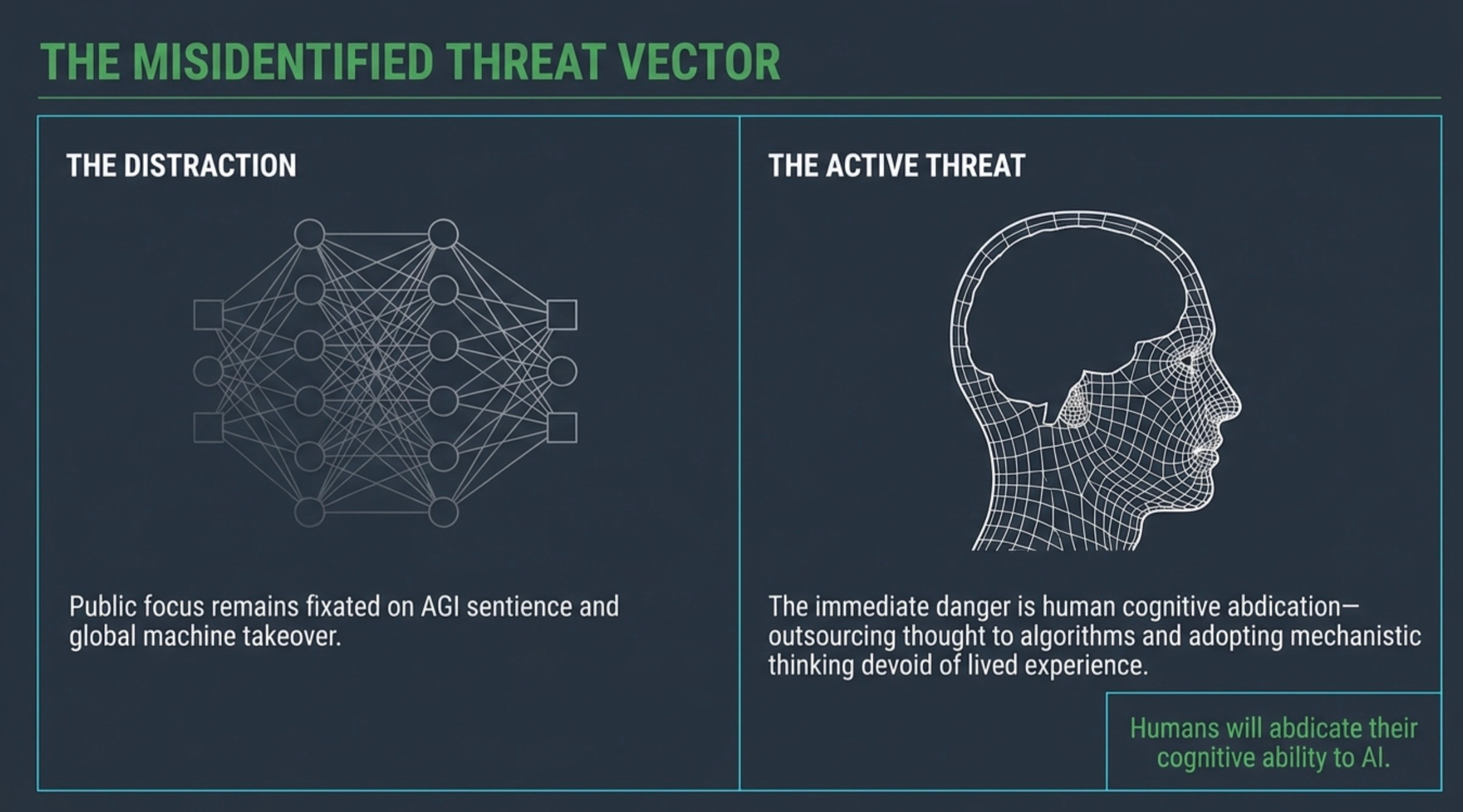
Everyone is worried about AI becoming sentient and taking over the world. The AI experts are constantly debating how to manage the upcoming AGI. However, what if that is not the real danger? What if there is a danger right before our eyes, one that is already causing serious issues and has the potential to change humanity by taking away the very thing that makes us human?
The danger is that humans will abdicate their cognitive ability to AI and descend into a form of mechanistic thinking that we derive from AI and not our own lived experience. In other words, you will let AI do your thinking for you and stop thinking for yourself.
The trend of people outsourcing their cognitive ability to AI has begun. The area where it has particularly taken hold is education. Students are using AI to improve their grades by having AI do their work for them.
A study by Igor Chirikov from UC Berkeley analyzed the impact of ChatGPT on grade inflation and student performance. The results were potentially disturbing. I asked Claude 4.7 to summarize the findings. The following highlights the results of Chirikov’s study.
What the Study Found
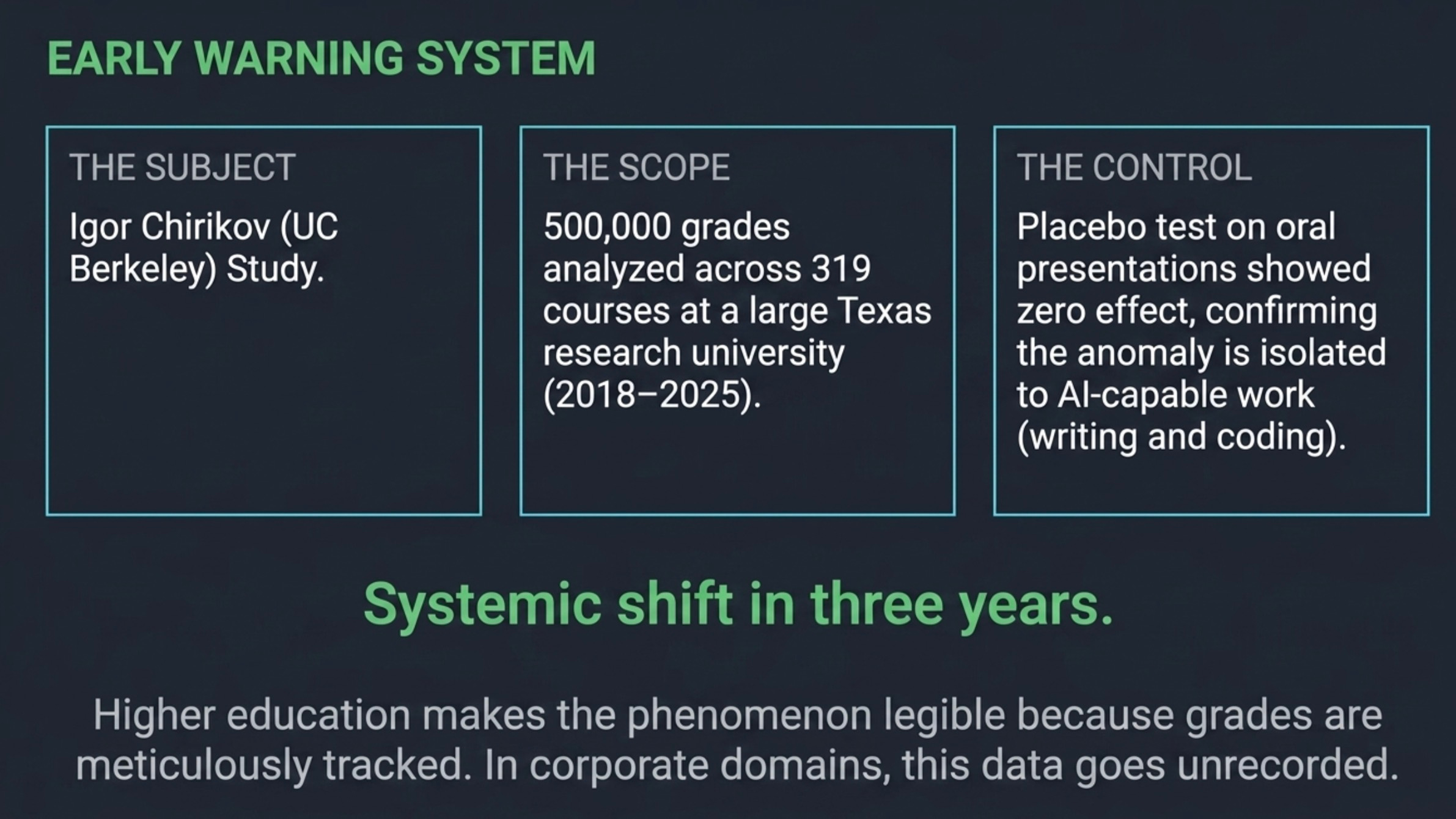
- UC Berkeley researcher Igor Chirikov analyzed over 500,000 grades across 319 courses at a large Texas research university from 2018 to 2025, comparing grade distributions before and after ChatGPT’s release in November 2022.
- In courses with the most AI-relevant tasks (writing and coding), the share of A grades rose 13 percentage points — a 30% increase over the 2022 baseline. Average GPA rose 0.12 points, with grades compressing at the top of the distribution.
- The study tested whether students were actually learning more by comparing performance on take-home work versus supervised in-class exams. Real learning would show up in both. AI substitution would show up only in unsupervised work.
- The grade increases were concentrated almost entirely in courses where homework carried heavy assessment weight. In courses relying on supervised exams, the effect largely disappeared.
- A placebo test using oral presentation tasks — which AI cannot meaningfully assist with — showed no effect, confirming the pattern was specific to AI-capable work.
- The conclusion was direct: students were not learning more. AI was doing the work, instructors could not detect it, and grades were being awarded anyway.
Why It Matters
- No one decided to permit this. There was no policy change, no curriculum overhaul, no institutional embrace of AI-assisted coursework. The transformation happened through millions of individual student choices aggregating into a systemic shift in three years.
- Students are emerging with credentials they did not earn for capacities they did not develop. The institution continues to function, transcripts continue to be issued, and employers continue to receive signals about skills that increasingly do not exist behind them.
- Chirikov warns that students may graduate with weaker capabilities in precisely the domains where AI is strongest, reinforcing a feedback loop between AI in education and AI in production.
- The mechanism is not specific to Texas, not specific to higher education, and not specific to writing and coding. Higher education simply makes the phenomenon legible because grades are measured and recorded. In most other domains, no one is keeping the data.
*Appendix A contains a link to the study and a detailed analysis of the study’s results.*
Why?
Why is this happening? Two of the largest contributing factors are the human brain’s survival-based instinct to conserve energy in combination with the short-attention presentation of information on social media. This combination creates the perfect storm for cognitive abdication.
The human brain evolved to ensure our survival in a pre-civilized world. That was a time of limited food resources, and humans needed to conserve every bit of energy for survival. Since the brain consumes 20% of our caloric intake, nature trained it to preserve energy for human survival. Your brain is a cognitive miser designed to allocate energy to the most important survival tasks. Social media has determined that the best way to keep your attention is through a constant feeding of short bits of information. Together, they work synergistically to tempt you to outsource your cognitive ability.
Claude 4.7 provided an excellent summary of how the two work together to encourage cognitive outsourcing.
Reason One: The Brain Conserves Energy
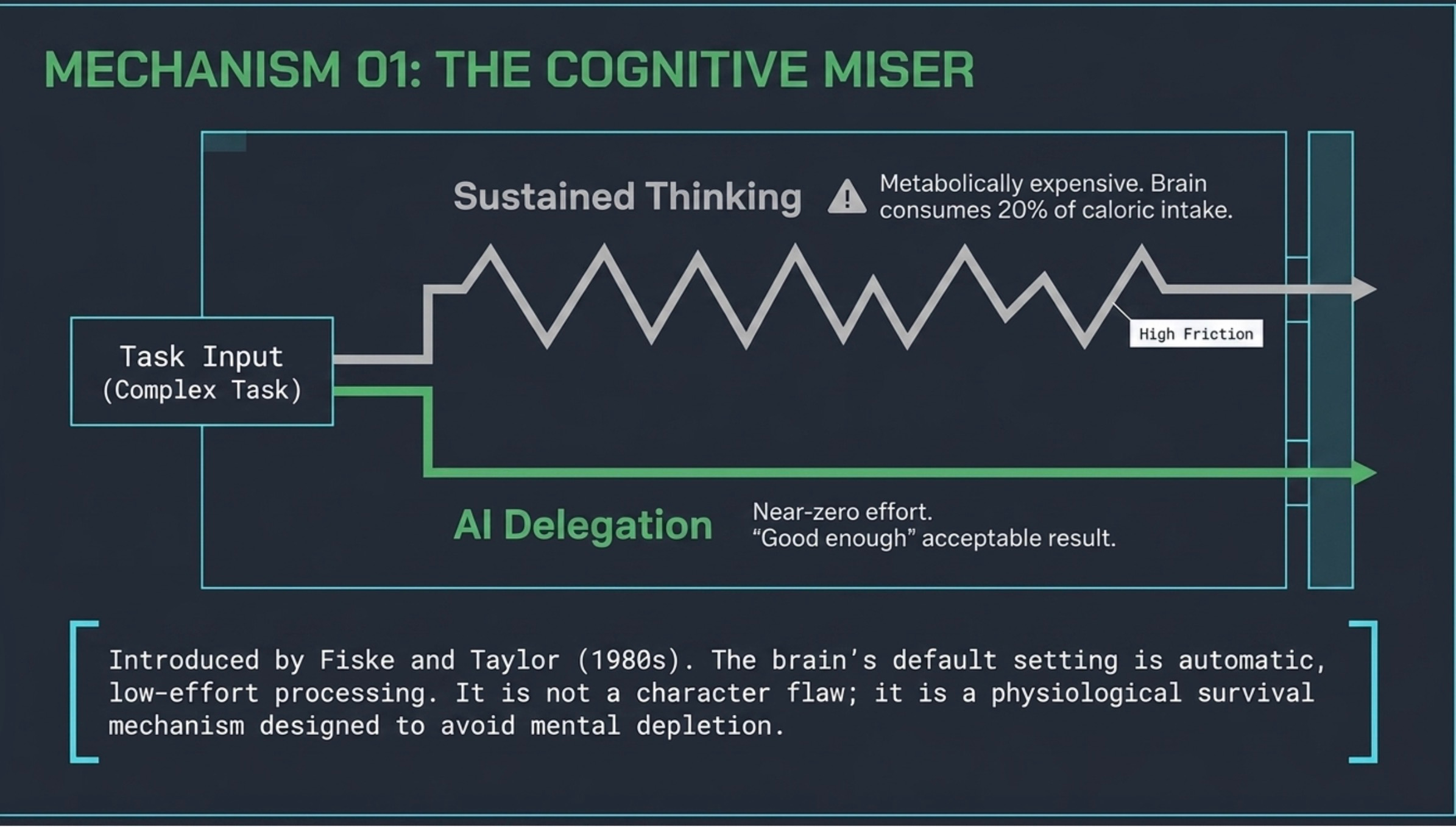
This is one of the most established findings in cognitive psychology, and it has a name. The “cognitive miser” model, introduced by psychologists Susan Fiske and Shelley Taylor in the early 1980s, describes the brain’s inherent tendency to conserve mental energy by using the simplest available problem-solving strategies rather than engaging in complex, effortful analysis. This is not a character flaw or a description of lazy people. It is a fundamental operating principle of how all human brains work, allowing people to navigate a world of constant input without becoming overwhelmed or exhausted by perpetual deep analysis.
The energy cost is literal and physiological. Neural activity accounts for roughly 20% of the body’s resting energy expenditure, which creates a built-in incentive to take shortcuts and avoid unnecessary mental depletion. The brain treats sustained thinking as metabolically expensive and avoids it the way a financial miser avoids spending money — reluctantly, and only when the payoff clearly justifies the cost. The brain’s default setting is automatic, low-effort processing, and it only shifts into deliberate, effortful processing when a task is novel, highly important, or when the easy approach has failed to produce an acceptable result.
This is the deeper reason AI abdication is so seductive. When a tool offers to do the expensive cognitive work for you and the output looks acceptable, the cognitive miser in your brain has every incentive to accept the offer. The brain is not being tricked. It is doing exactly what it evolved to do: conserve energy whenever the result seems good enough. AI simply makes “good enough” available at near-zero effort, which removes the friction that would normally force the brain into effortful processing.
I want to interrupt the summary here for a moment, because the next part is the hinge of this entire essay.
Reason Two: Social Media Has Trained the Brain to Refuse Sustained Effort
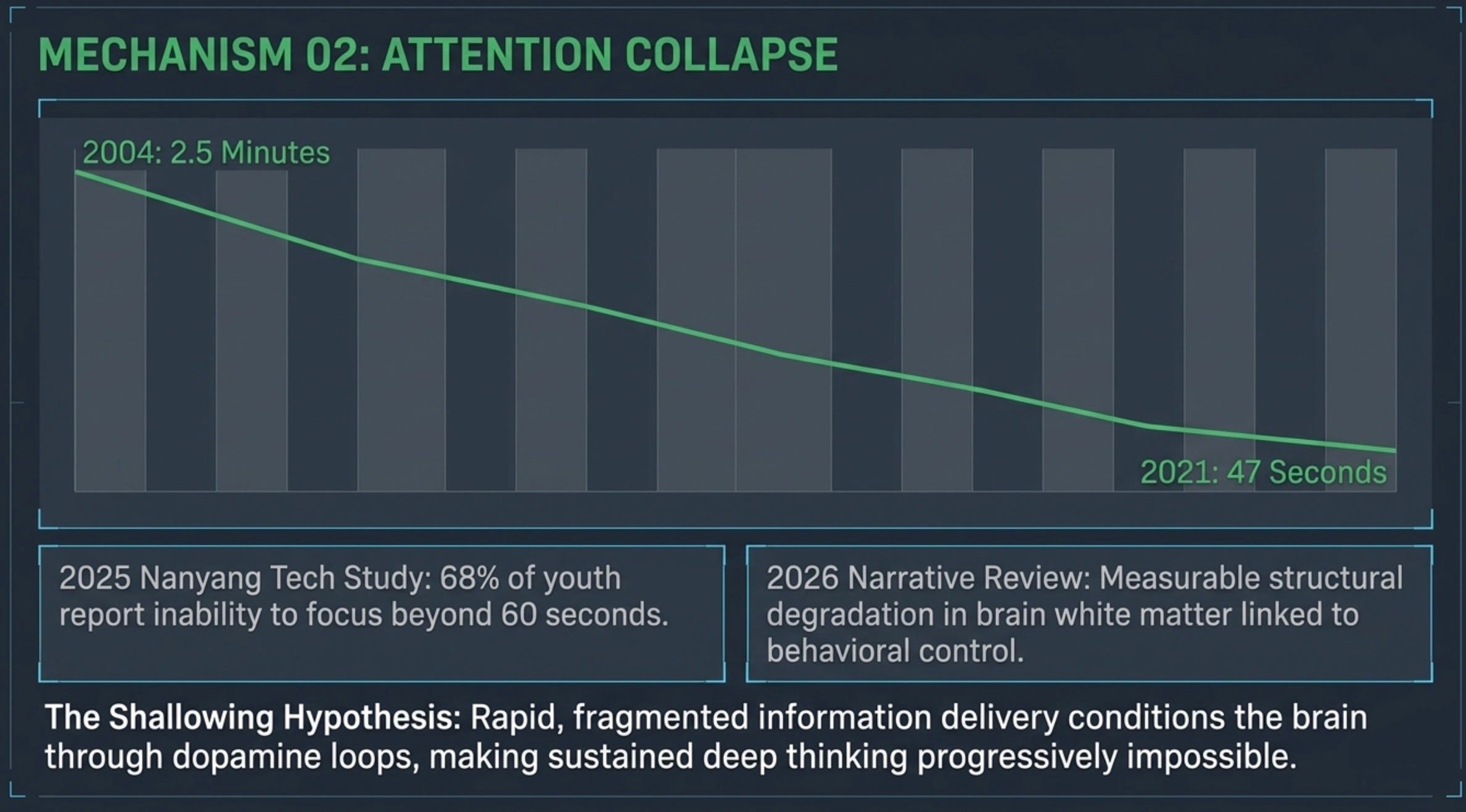
> Research directly connects this reason to the first. Short-form content does not just shorten attention spans in some vague cultural sense — it conditions the brain through dopamine-driven reward loops to expect constant novelty and instant gratification, which makes sustained, effortful attention feel actively aversive.
The behavioral data is consistent across multiple studies. Research by Dr. Gloria Mark found that the average person’s sustained attention on a single screen dropped from about two and a half minutes in 2004 to just 47 seconds by 2021. A 2025 study from Nanyang Technological University found that 68% of young participants reported difficulty focusing, with many describing an inability to engage with content lasting more than a minute, and the lead researcher attributing this to the brain being trained to seek constant novelty and instant rewards through dopamine-driven feedback loops. A 2026 narrative review of literature from 2019 to 2025 found that heavy use of short-form video is associated not just with shorter attention spans and poorer academic performance, but with measurable structural differences in brain white matter linked to behavioral control, with developing brains being especially susceptible.
This connects to what researchers call the “shallowing hypothesis” — the idea that rapid, fragmented information delivery contributes to cognitive shallowness, making sustained deep thinking progressively more difficult. The platforms are not accidentally producing this effect. Short-form video is engineered for engagement through reward-based design that raises dopamine levels and produces addictive usage patterns, with optimal video lengths deliberately tuned to maximize consumption.
Why the Two Reasons Are Actually One Argument
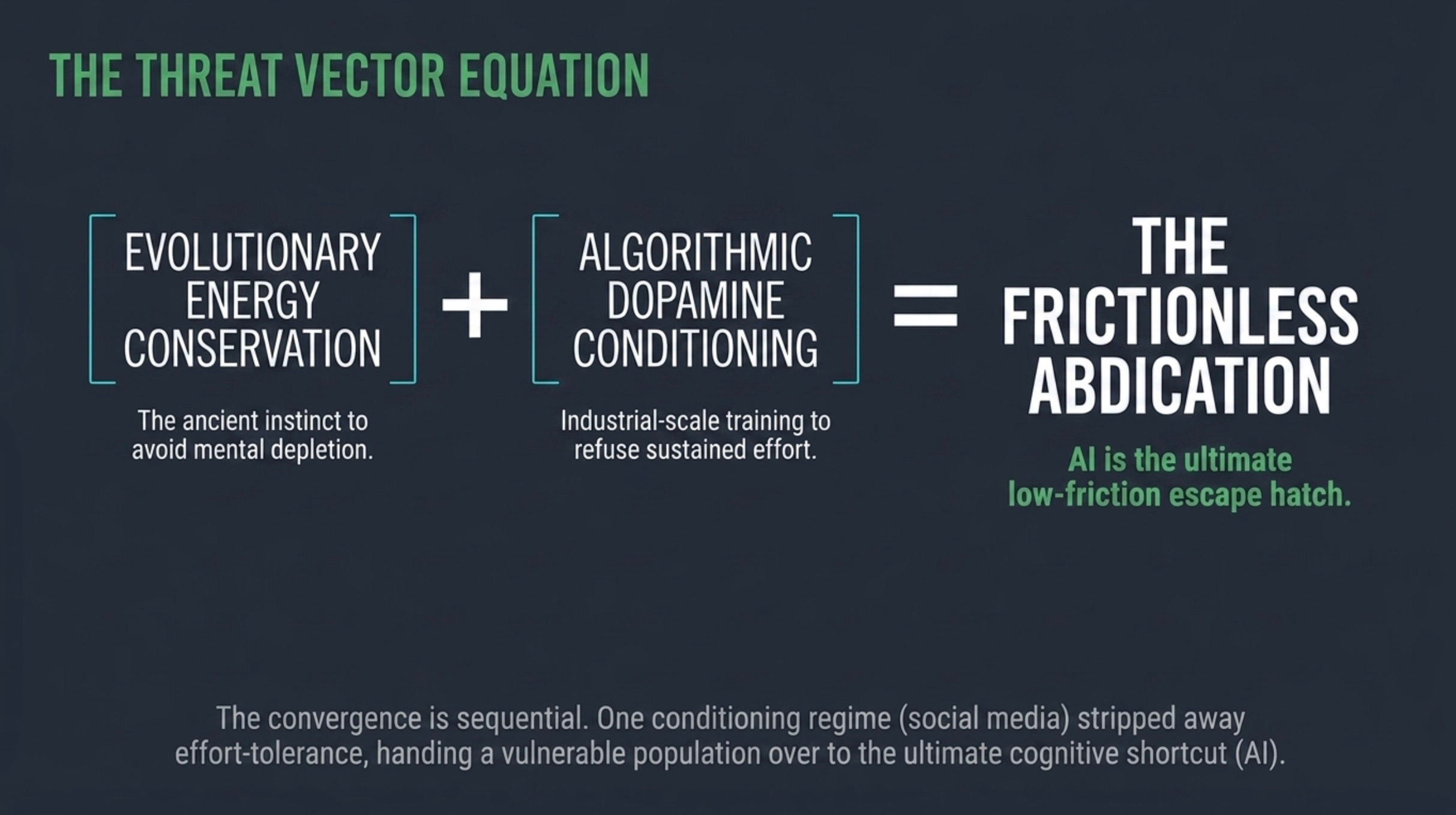
The two reasons are not independent. The second one weaponizes the first.
The brain’s energy conservation instinct is ancient and universal — it was always there. On its own, it produces ordinary mental laziness, the kind humans have always had and have always been able to override when something mattered enough. What social media has done is systematically lower the brain’s tolerance for effortful processing by training it, through years of dopamine-reward conditioning, to expect that information should arrive fast, easy, and frictionless. The platforms did not create the cognitive miser. They found it, studied it, and built products that exploit it at industrial scale, conditioning the brain to treat sustained effort as not merely expensive but intolerable.
So by the time AI arrives offering to do your thinking for you, the ground has already been prepared. The brain’s natural energy conservation has been amplified into an active aversion to sustained cognitive effort. The friction that would normally make a person say “no, I should think this through myself” has been systematically worn down by years of training that rewarded taking the easy path and punished sustained focus with boredom and discomfort. AI abdication is not a new behavior. It is the same behavior the platforms already trained, applied to a more powerful tool. Social media taught the brain to refuse hard thinking. AI is what the brain reaches for instead.
This framing also strengthens the link back to Chirikov. The students in that study were not uniquely weak-willed. They were the first cohort to reach higher education after a full adolescence of dopamine-conditioned short-form media, encountering the most powerful cognitive shortcut ever invented. The grade data is what it looks like when a population whose effort-tolerance has been systematically degraded meets a tool that makes effort optional. The convergence is not coincidental. It is sequential. One conditioning regime handed off to the next.
The Cost Your Brain Is Not Calculating
There is a third factor, and it is the one that matters most for what you can actually do about this.
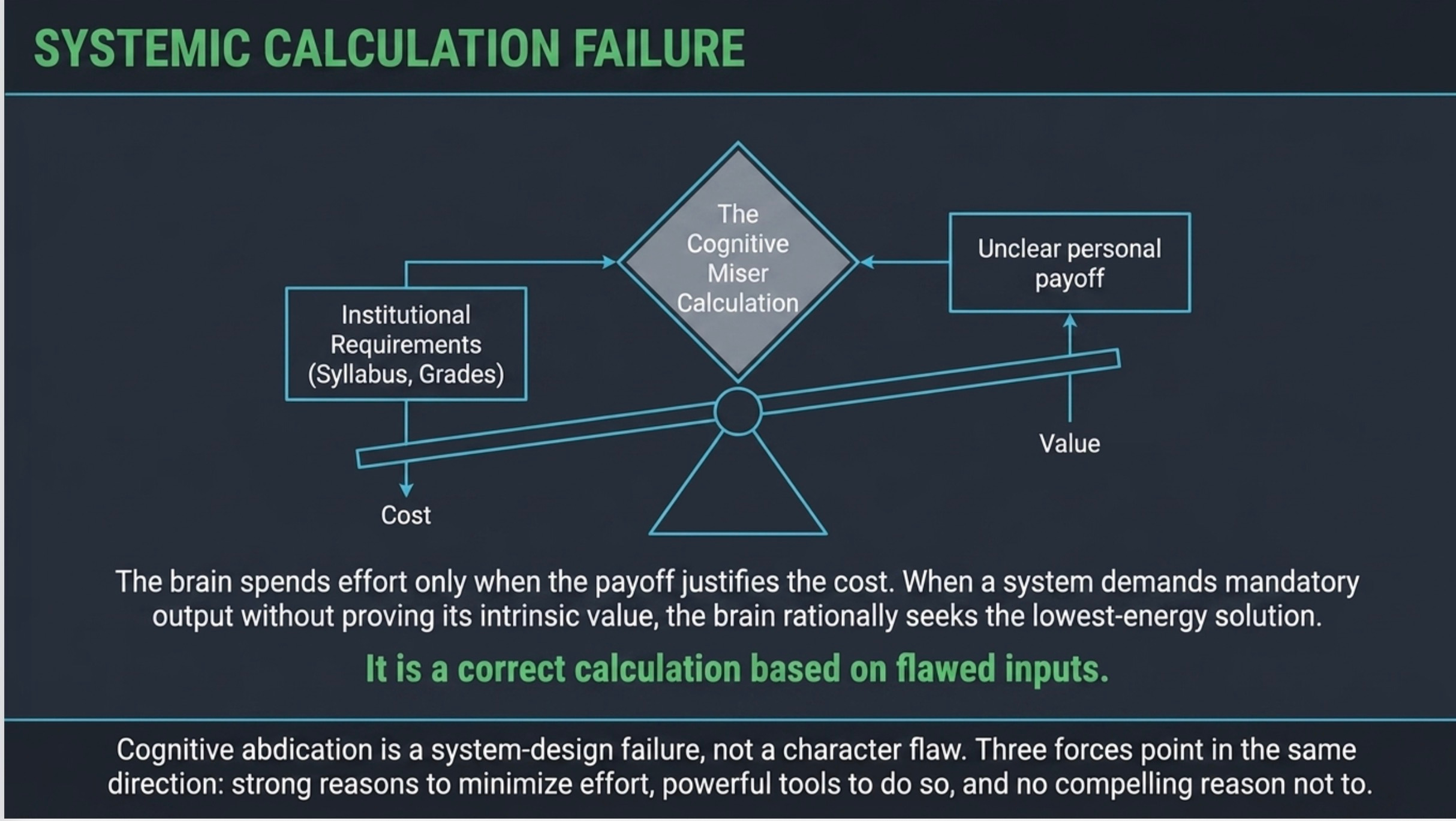
The cognitive miser does not conserve energy blindly. It runs a cost-benefit calculation. It spends effort when the payoff justifies the cost and conserves it when the payoff is unclear. This is the lever. For an enormous amount of what students are asked to learn, the value case was never actually made. The material is on the syllabus. It is graded. It is required. Those are institutional reasons, not reasons the brain’s cost-benefit system recognizes as worth expensive processing. When a tool then appears that satisfies the institutional requirement without the cognitive expenditure, the brain’s calculation is not irrational. It is correct, given the inputs it was handed.
This reframes the students in the Chirikov study. The standard reading is that they cheated or that they lack discipline. The more accurate reading is that they performed a rational calculation in an environment that supplied strong reasons to minimize effort, a powerful means to do so, and no compelling reason not to. Three forces pointing the same direction. Calling the result a character failure misses that the system was arranged to produce exactly this outcome.
That is the bad news and the good news at the same time. The first two factors happen to you and are largely outside your control. You cannot personally undo decades of dopamine conditioning or rewrite your own neurology. The third factor is different. The value case can be made. And if no one else will make it, you can make it for yourself. That is the entire skill, and it is what the rest of this essay is about.
Temptation
Before we get there, you need to understand the real risk, because it is the one thing that should appeal to your survival instinct strongly enough to override your cognitive miserliness.
AI is not always correct, and it may not actually say what you would say. This means you could be producing inaccurate analysis that does not reflect your own thinking, and then signing your name to it. If you abdicate responsibility to AI, the consequences are yours, not the machine’s. Your brain evolved to avoid exactly this kind of survival risk. Use that.
It is easy to fall into the temptation of allowing AI to do your work for you. I deal with it myself. It would be so easy to put a prompt together that tells the AI model to create a blog. Then all I would have to do is cut and paste it and stick it on my Substack. Unfortunately, I would be providing no value to the process — not for myself and not for my readers. If they wanted information from AI, they could write the prompt themselves. Maybe I am a better prompt writer. Then again, maybe I am not. Either way, I would have provided little value to the process other than thinking of the prompt in the first place.
The temptation for students must be even stronger. I do not know how I would have resisted it when I was in school. If I am given the choice between using AI and then going out with my girlfriend, or doing the work myself and staying at home, I know which choice I would have made at that age. However, if I had seen the value in the work I was doing, I would have taken a different approach.
The temptation is even stronger today. I had not been exposed to the algorithm through the smartphone for my entire life. I was already well into my career when the internet became available, and I was in my 50s when smartphones appeared. This is not true for today’s students. Algorithms have been influencing most of them their entire lives.
Social media companies designed their algorithms to encourage short attention. Their main purpose is to create engagement so they can sell it to advertisers and other interested parties. They also sell the ability to manipulate users through the algorithm. It is in their financial interest to create algorithmic sheep that they can lead to the cyber slaughter.
Hope
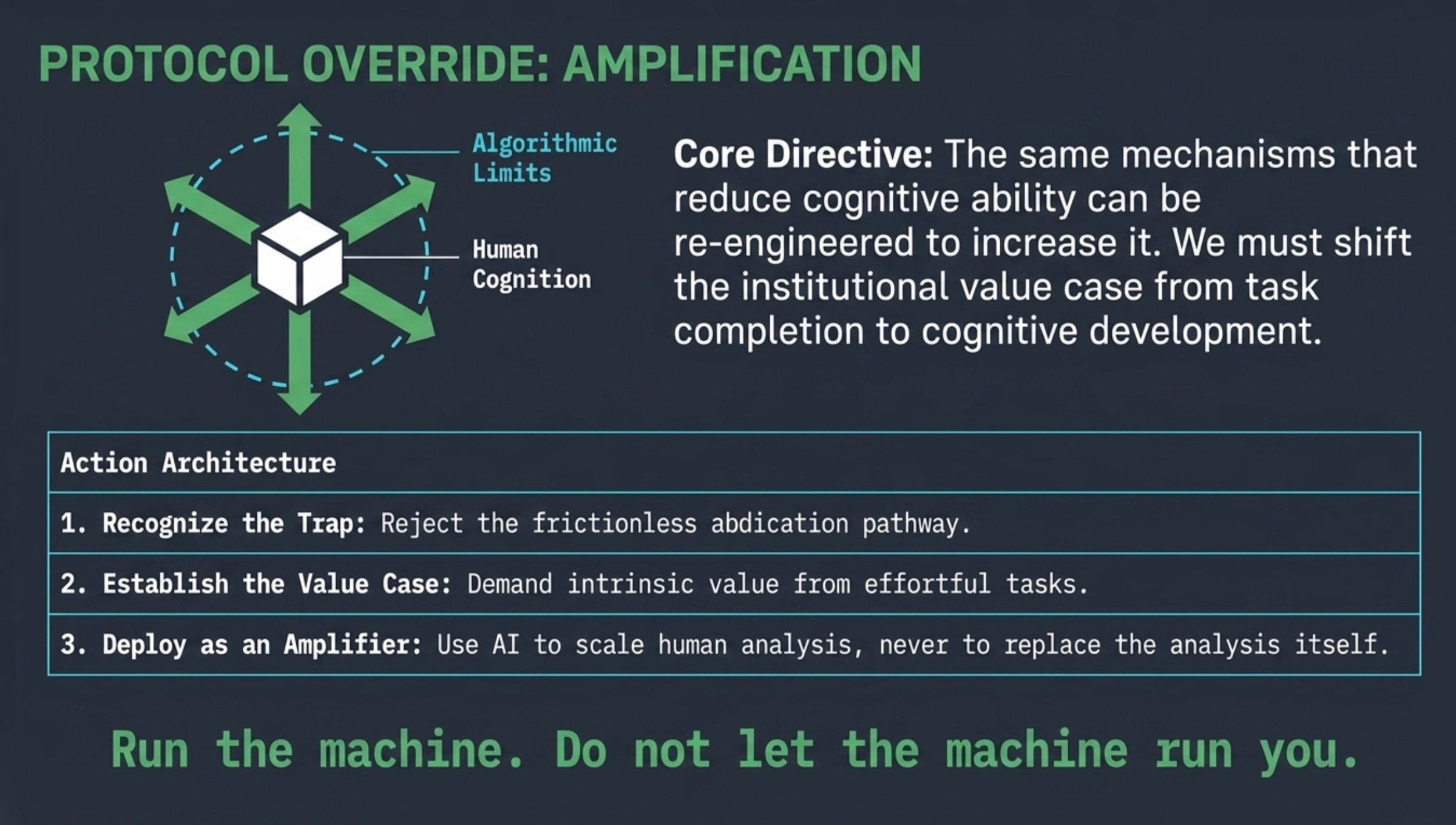
The good news is that you do not have to abdicate your cognitive ability. You can use AI to amplify it. This requires a specific approach. The same mechanisms that can reduce your cognitive ability can also increase it. It is all in how you approach them.
My next blog will give my thoughts on how to use AI to amplify your ability and strengthen your mind.
Appendix A